Showing posts with label Learning Styles. Show all posts

Tuesday, 4 November 2014

Animation for learning?

Since the early 1980's animation has been used in learning, with the continuous evolving of technology and learners ability to use the software, education through animation has become increasingly popular.

One of the reasons as to why animation has become so popular is the belief that it can help learners understand and process difficult topics or subjects easier than the traditional teaching.(Ainsworth, 2008) But does animation help learners? If so how?

Today more and more schools are using animation within education and learning as an alternative method. Learning can be seen as a complicated process by some and can find the process of understanding and obtain the knowledge difficult. Every individual is different and unique which means we all learn in different ways, therefore having their own preferred learning style. 
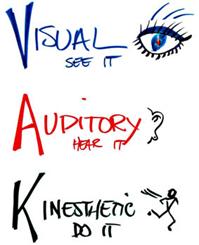

Visual learners who 'show me and I understand' will benefit from learning a topic through animation. Using diagrams, images and charts will help them with the knowledge.


Auditory learners tend to benefit from the most traditional teaching styles.


Kinesthetic learners tend to be 'more hands on', they learn through experimenting and doing so animation can be used to help these type of learners too.


The way an individual absorbs, processes, comprehends and retains information is important. The Educational theorist Neil Flemmings explains the learning styles in his VARK theory. 


References

Ainsworth, S. (2008) 'How do animations Influence Learning?', in D. Robinson and G. Schraw (eds.) Current Perspective on Cognition, Learning, and Instruction: Recent Innovations in Educational Technology that Facilitate Student Learning

Lowe, R. K. (2003) Animation and Learning: Selective Processing of Information in Dynamic Graphics. Learning and Instruction


Monday, 13 October 2014

What is a learning environment?

Learning environment is referred to as the diverse physical, context and cultural location a person may learn. Since students are thought of the as the most typical learner, which have numerous learning environments but the classroom being the main environment. It is a classroom which is most commonly thought of when referring to a learning environment. But is this right? 

What is a good learning environment?


I personally believe a good learning environment is place which stimulates and engages children. Whilst at the same time is encouraging children to learn by making them feel comfortable within the environment.

Where do people go to learn? What do those places look like?

Anywhere! Home, classrooms, community centres, outdoors, peers etc.
A learner can constantly be learning new things. 
Learning takes place in multiple settings and the learning environment can be structured or unstructured. Learning in different environments can complement each other. 
Formal and non-formal education occurs mainly in structured environments in the form of institutions. Informal education on the other hand takes place in both structured and unstructured environments.

How does the arrangement of a learning space contribute to—or detract from—the task of education?

It's important for the learner to feel comfortable within their learning environment. If the learner is not engaging and stimulated they will lose interest.
A reason for this is all students are unique and learn in different styles which hellos them absorb and process the information and knowledge being taught. Responsibility for this falls upon the educator, it's up to them to find what works best for their students as what works for some, may not work for others.

So how important is the learning environment?

The learning environment is very important to a persons learning and education. However, it's not the only factor which contributes to a persons education and learning but is important.

References

http://www.unesco.org/new/en/education/themes/strengthening-education-systems/quality-framework/core-resources/learning-environment/